The UK Scaffolding Skills Crisis Is Here (And It’s Bigger Than You Think)
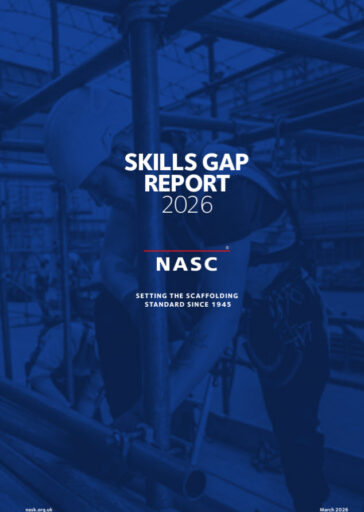
The NASC Skills Gap Report 2026 has put a number on something every scaffold business owner in the UK already… Read More

What the NASC (National Access & Scaffolding Confederation) retirement data means for operational continuity and how software protects scaffolding knowledge transfer
One of the quieter findings in the NASC Skills Gap Report 2026 carries the most long-term weight. Around 7% of directly employed staff across NASC member businesses are within four years of retirement. Based on current membership levels, that represents over 1,400 experienced workers (scaffolders, advanced scaffolders, supervisors, and managers) leaving those member businesses by 2029. For another 17% of employees, retirement timing is unknown, meaning the real figure could be significantly higher.
And while the sector focuses rightly on recruiting new entrants, there is a second, critical challenge that receives far less attention: what happens to the knowledge those experienced workers carry when they leave?
Every business loses staff over time. But the retirement of experienced scaffolding professionals represents a different category of loss. It is not just headcount; it is accumulated knowledge. It is the site supervisor who knows which ground conditions flag a problem before an inspection report surfaces it. It is the contracts manager who knows how to read a Tier 1 contractor’s correspondence and identify the scope creep buried in the language. It is the advanced scaffolder who knows which modifications are routine and which require escalation.
The NASC report puts this plainly: it is impossible to equip a new entrant with decades of experience. The institutional knowledge walking out of the sector over the next four years cannot simply be replaced by hiring at volume. It has to be captured, documented, and made accessible in ways that do not depend on one person being available.
The knowledge transfer problem
Most scaffold businesses carry their operational knowledge in people’s heads and on paper: site inspection records, handover notes, modification histories, and client correspondence. These exist, but they exist in formats that are difficult to interrogate, impossible to search, and entirely dependent on someone knowing where to look.
When the person who knows where to look retires, that knowledge does not leave with a formal handover briefing. It leaves gradually, across dozens of small decisions and conversations that never get documented, until one day a new project manager is managing a complex site with no institutional memory to draw on.
ScaffoldIQTM directly addresses this problem. By centralising inspection logs, modification requests, approval histories, site photographs, and handover documentation in a single digital platform, it ensures that the operational intelligence of a project lives in the system, not in the person. A new team member inheriting a site has the same visibility as the experienced manager who set it up. The knowledge transfer that previously happened informally, or not at all, becomes structural and automatic.
The retirement wave and the recruitment drive are two sides of the same coin and they interact in a way the NASC data makes visible.
Trainees and labourers currently account for 24% of the NASC member workforce between them, and they represent 36% of current vacancies. The sector is actively recruiting junior staff into a gap left by experienced ones exiting.
That transition only works if the new entrant has something to learn from. In a traditional scaffold business, a trainee learns by working alongside experienced scaffolders and supervisors, absorbing the institutional knowledge that never gets formally documented. When those experienced people are stretched across more sites, carrying more administrative burden, and in some cases approaching the end of their careers, the quality of that informal transfer degrades.
ScaffoldIQ includes clear guardrails so junior staff can develop competence without requiring constant senior oversight. When inspection workflows are guided by the platform, modification requests follow a defined approval path, and site documentation is standardised across every project, a less experienced team member has a framework to operate within rather than relying entirely on a mentor’s physical presence. The experienced supervisor’s time is directed at the decisions that genuinely require their judgment, not at hand-holding administrative processes a structured system could guide.
The retirement wave and the recruitment drive are two sides of the same coin. The transition only works if the new entrant has something to learn from.
The report found that recruitment pressure is most acute in the areas most affected by retirement risk: scaffolders and advanced scaffolders. These are the operational backbone of any scaffolding firm. As 46% of survey respondents already report increased workload for existing staff as a consequence of unfilled vacancies, the additional pressure of experienced retirement without planned knowledge transfer creates a compounding risk.
The firms best positioned to manage the retirement transition are those that begin building digital operational infrastructure before the departures happen, not after. Once an experienced supervisor retires, the opportunity to capture their working knowledge in a structured way is largely gone.
ScaffoldIQ and the broader Avontus platform give businesses the tools to build that infrastructure now, so that when the retirement wave arrives, the knowledge it carries is already embedded in the system rather than walking out the door.
If retirement is already thinning out your most experienced crews, the record you build now is what the next person inherits. Explore ScaffoldIQ to see how one platform holds your inspection logs, modification history, and handovers, so whoever picks up a site next gets full visibility instead of a gap to fill in. Or talk to our team about mapping it onto your current sites.
The report found that around 7% of directly employed staff across NASC member businesses are within four years of retirement. Based on current membership levels, that’s over 1,400 experienced workers, including scaffolders, advanced scaffolders, supervisors, and managers, leaving those businesses by 2029. NASC could not determine retirement timing for another 17% of employees, so the real number leaving in that window could be higher.
The 1,400 figure comes from NASC’s own UK member businesses, not the global scaffolding workforce. The underlying pressure, experienced staff retiring faster than their knowledge gets passed on, isn’t unique to the UK. Companies are impacted globally.
An experienced supervisor, contracts manager, or advanced scaffolder holds judgment that rarely gets written down: which ground conditions signal a problem before an inspection catches it, how to spot scope creep in a contractor’s correspondence, which modifications are routine versus which need escalation. A new hire adds headcount but not that judgment. Without a way to capture it, the judgment leaves with the person who retires.
ScaffoldIQ is Avontus’s platform for managing scaffold requests, inspections, modifications, and handovers in one system. It centralises a project’s inspection logs, modification requests, approval histories, site photographs, and handover documentation, so that record stays with the project rather than living in one person’s head or scattered across paper and email.
Before the departures happen, not after. Once an experienced supervisor retires, the chance to capture their working knowledge in a structured way is largely gone. Putting a system in place while that expertise is still on site keeps the option open.
The NASC Skills Gap Report 2026 has put a number on something every scaffold business owner in the UK already… Read More

For years, scaffold companies have relied on phone calls, spreadsheets, and paper trails to manage jobs. But as projects grow… Read More

Learn how scaffold QR codes connect field and office teams to live data. See how they compare with paper, NFC,… Read More