
From Bid to Build: How Scaffolding Software Supports Every Step of Scaffolding Projects
In today’s construction landscape, digital tools are reshaping how scaffolding companies operate—from the initial bid to project closeout. As the… Read More
The NASC Skills Gap Report 2026 has put a number on something every scaffold business owner in the UK already knows. Finding qualified people is getting harder, and the pipeline is not keeping pace with demand. The report identifies approximately 40,000 vacancies across the UK sector once you account for retirements and natural attrition. To be sure, this is not a projection. It is a structural reality that is already shaping how firms operate today.
And the timing makes it worse. The UK government has set out an ambitious pipeline of construction projects with a million new homes by the end of this parliament, alongside major national infrastructure and energy programs. Every one of those projects needs scaffolding before it can move. The logic is simple: if the scaffolders are not in post, not trained, and not ready to work, the projects will not get off the ground. The NASC report makes that point directly.
The report, based on survey responses from 151 NASC full member organizations, found that 56% companies reported at least one unfilled vacancy, with an average of 4.4 vacancies per firm. Extrapolated across the full NASC membership of 404 organizations, that represents approximately 1,760 current roles sitting empty. Scaffolders account for 36% of those vacancies, with advanced scaffolders and supervisors making up a further 21%.
And those are just the roles that are currently empty. A further 17% of the existing workforce has no confirmed retirement timeline, meaning firms are likely underestimating the real near-term attrition risk. Around 7% of directly employed staff are within four years of retirement. That alone equates to roughly 1,500 experienced workers leaving by 2029.
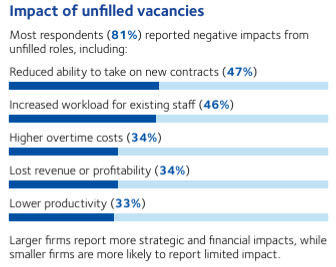
The impact is already operational. Eight in ten respondents reported negative consequences from unfilled vacancies: 47% said they had reduced capacity to take on new contracts, 46% reported increased workload for existing staff, and 34% cited direct loss of revenue or profitability.
NASC Skills Gap Report, March 2026
What makes this report particularly significant is the correlation between staffing and growth ambition. Two thirds of NASC member organizations expect turnover and staffing levels to increase over the next five years. But the report makes the dependency explicit: labor availability drives workforce expansion, meaning recruitment determines whether growth ambitions succeed or stall.
For businesses planning to scale, recruitment challenges can create a hard ceiling. You can’t take on more contracts if you can’t staff them. And with 83% of member firms expecting to need to recruit in 2026 alongside a projected 6000 roles across the full membership, the competition for a limited pool of qualified people will only intensify.
Software alone cannot close the skills gap. New entrants still need CISRS training. Experienced workers approaching retirement still need successors. These are pipeline challenges that demand coordinated action from industry, training providers, and government.
But while the industry rebuilds that pipeline, scaffold businesses need to operate more efficiently with the workforce they have. This is where Avontus Software changes the equation.
With 46% of firms reporting increased workload from vacancies, every hour lost to admin is an hour not spent on billable work. Avontus ScaffoldIQ™ gives that time back.
ScaffoldIQ gives every field and office team member real-time visibility of every scaffold’s status, inspection history, and modification record from a single platform. Knowledge that previously sat with one person becomes digital and transferable across the wider team. Teams report inspection logs instantly rather than collating them manually. And businesses that run lean keep their administrative load under control.
Understaffing also erodes margin in ways that are easy to miss. When stretched teams stop logging every scope change, they complete work that nobody invoices. ScaffoldIQ’s approval workflow ensures teams log, approve, and attach every change to the scaffold record before settling the final account.
The report highlights a significant regional imbalance in vacancy pressure. Wales reports an average of 9.3 vacancies per organization, more than double the national average of 4.4. Scotland reports 6.5. The North West sits at 5.6. For firms operating in these regions, the challenge of doing more with less is not a future scenario; it is today’s operating reality.
For businesses in higher-pressure regions, operational tools that reduce friction and extend the productivity of existing staff are not a nice-to-have. They are a competitive necessity.
The NASC Skills Gap Report 2026 confirms that workforce pressures are real, sustained, and intensifying. The firms that navigate this best will combine investment in training and recruitment with smart operational tooling that protects capacity and margins in the meantime.
Avontus Software exists to help scaffold businesses run more efficiently with the workforce they have. ScaffoldIQ, Quantify®, Avontus Designer® and Avontus Viewer® (available as a free download) help businesses level up: protecting margin, improving site visibility, and directing every hour of experienced labor at the work that actually requires it.
Want to see Avontus Designer in action? Book a demo with our team today and try it out for yourself.
The NASC Skills Gap Report 2026 identifies approximately 40,000 vacancies across the UK scaffolding sector once retirements and attrition are accounted for. Among members surveyed, 56% reported at least one unfilled role, averaging 4.4 vacancies per firm; an estimated 1,760 empty roles across the full NASC membership.
The NASC Skills Gap Report 2026 surveys 151 NASC full member organizations across the UK. It quantifies current vacancy levels, near-term retirement risk, and the operational impact of understaffing on scaffold businesses. The report identifies the skills shortage as a structural challenge threatening both business growth and the UK’s wider construction program.
Wales is the most acutely affected region, reporting an average of 9.3 vacancies per organization, more than double the UK national average of 4.4. Scotland reports 6.5 vacancies per firm on average, and the North West reports 5.6. For scaffold businesses operating in these regions, workforce pressure is already an immediate operational reality rather than a future risk.
The impact is already being felt operationally. According to the NASC Skills Gap Report 2026, eight in ten respondents reported negative consequences from unfilled roles. Specifically, 47% said they had reduced capacity to take on new contracts, 46% reported increased workload for existing staff, and 34% cited direct loss of revenue or profitability.
Around 7% of directly employed staff within NASC member organizations are within four years of retirement. This equates to approximately 1,500 experienced workers expected to leave the industry by 2029. A further 17% of the existing workforce has no confirmed retirement timeline, meaning the real attrition risk in the near term may be significantly underestimated.
Yes. While software cannot replace the need for trained scaffolders, it can significantly reduce the administrative burden on existing teams. Avontus ScaffoldIQ™ gives field and office staff real-time visibility of every scaffold’s status, inspection history, and modification record from a single platform, reducing the time spent on manual records, paper-based handovers, and email-based coordination. This frees experienced workers to focus on billable, skilled activity rather than administrative overhead.
Understaffing erodes margin quietly; when scope changes go unlogged, work gets completed but never invoiced. ScaffoldIQ’s approval workflow ensures every change is logged, approved, and attached to the scaffold record before final account. This closes the gap between work done and work billed.
Avontus offers a suite of scaffolding management tools built for the UK market: ScaffoldIQ™ for site visibility and inspection management, Quantify for estimating and materials management, Designer for scaffold design, and Viewer, a free tool for accessing scaffold drawings on site. Together, these products are designed to help scaffold businesses protect margin, improve operational efficiency, and do more with the workforce they have.
Almost certainly in the short term. The UK government has committed to building one million new homes within this parliament, alongside significant national infrastructure and energy projects. Every one of those projects requires scaffolding before construction can begin. The NASC report makes the dependency explicit: if qualified scaffolders are not available and trained, major parts of the government’s construction pipeline will face delays.
Scaffolders account for 36% of current vacancies among NASC member organizations. Advanced scaffolders and supervisors represent a further 21% of unfilled roles. The shortage is therefore concentrated not just at entry level but also among the more experienced, senior workers who are hardest to replace and most critical to operational delivery.
In today’s construction landscape, digital tools are reshaping how scaffolding companies operate—from the initial bid to project closeout. As the… Read More

Here's what's new on the Avontus website. Read More

What separates thriving scaffolding companies from the rest? In a competitive and increasingly digitized construction environment, success is defined by… Read More