For decades, scaffolds have been marked with paper or plastic tags showing whether they are safe to use. While these tags bring visibility to safety practices, they convey limited information, rely on manual updates, and may be outdated by the time a worker uses the scaffold. That’s why scaffold QR codes—also known as QR-coded scaffold tags—are becoming the industry standard.
While basic QR tags may only link to static data, modern QR-coded scaffold tags connect to live digital systems, giving crews and managers real-time access to scaffold status, inspections, handovers, and safety records. More than just labels, these connected tags integrate directly with platforms such as ScaffoldIQ™.
In this article, we’ll explore how scaffold tags have evolved, what to look for in a modern QR-tagging system, and why QR-coded scaffold tags are a smarter choice than paper tags and more cost-effective than RFID or NFC alternatives.
How Scaffold QR Codes and Tags Have Evolved
The move toward connected tags has been gradual.
Traditional tags use plastic holders and colored inserts to label a scaffold as safe to use, unsafe, or OK to use with caution. Inspectors must update them manually.
Early QR-coded tags link to limited, static data. These codes improve visibility but are not connected to real-time data.
Today’s connected scaffold tags include QR codes scanned with phones or tablets, NFC (near-field communication) tags opened with compatible phones, and RFID (radio frequency identification) tags read by scanners. These smarter tags can provide up-to-date information on inspections, handovers, and safety documents, and more depending on the features of the associated platform.
QR vs. NFC vs. RFID vs. Paper (at a glance)
Type & Typical Cost
How crews access data
Hardware needed
Strengths
Best fit
Paper tag
Very low
Read printed insert
None
Simple, universal
Basic compliance
QR code
Free to pennies
Scan with any phone or tablet camera → opens live record in app/URL
Smartphone or tablet
Phone-based, easy rollout, real-time access
Most scaffold sites
NFC tag
~$0.20–$2+
Tap with compatible phone or tablet → opens app/URL
NFC-enabled smartphone or tablet
Quick tap with gloves; durable embedded chip
Access points or assets where scanning isn’t practical (gloves, low light, heavy wear)
RFID tag
~$1–$10+
Reader scans ID → record retrieved in system (cloud or on-prem)
Handheld/fixed RFID reader + software
Bulk/rapid reads; no line-of-sight
High-volume inventory yards and logistics
Not All QR-Coded Scaffold Tags Are the Same
It’s important to understand that the QR code itself isn’t what makes a scaffold tag smart. A QR code is simply an identifier — it can point to almost anything.
Basic QR-coded tag: Some companies use QR codes that link to static data. This eliminates paper but still requires manual updates. The tag doesn’t reflect if the scaffold has changed since the last inspection.
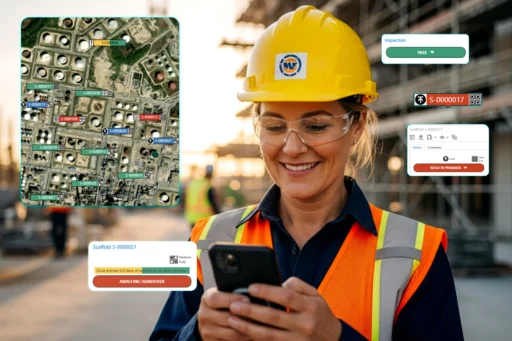
Integrated QR-coded tag: In contrast, a QR-code tied to a scaffold management system (like ScaffoldIQ) becomes a live access point. Each QR code has a unique ID linked directly to the scaffold’s record in the platform. When scanned, ScaffoldIQ’s QR code displays the entire scaffold record. When a scaffold is updated in ScaffoldIQ, a scan of the QR code allows you to see the most current, relevant data.
The takeaway: The real value isn’t the QR code itself — it’s the platform behind it. Without integration, a QR tag is just a smarter sticker. With integration, it’s a window into the scaffold’s entire lifecycle.
Why QR-Coded Scaffold Tags Matter for Safety and Compliance
Every major regulatory body—OSHA (U.S.), HSE (U.K.), SafeWork (Australia)—requires scaffolds to be inspected regularly and clearly marked. Paper tags meet the minimum, but QR-coded tags go further by enabling:
Tamper-proof records: Inspections are date-stamped and logged, reducing falsification.
Instant worker confidence: A quick scan confirms whether a scaffold is safe to use.
Traceable documentation: Inspection, handover, and activity records are digitally stored, providing clear proof of compliance when requested.
The result? Increased transparency between trades, fewer accidents, stronger compliance, and smoother site operations.
A scaffold’s QR code and live, linked data in ScaffoldIQ
Key Features to Look for
Real-time updates & mobile access: On scan, workers see the current status and details pulled directly from the scaffold platform—not last week’s insert.
Integration with your scaffold software ecosystem: Look for direct links from the tag to your system. ScaffoldIQincludes status, location, handovers, inspection results, activity details, drawings, site photos, and safety documents (including Risk Assessments and Method Statements (RAMS) in the UK).
User-friendly interface: Technology only improves safety and efficiency if workers use it. One scan should surface what actions need to be taken immediately and inspectors should be able to complete checklists in minutes while in the field.
Multi-platform support: Works on Windows desktop, web, iOS, and Android—so crews can use the phones or tablets they already carry.
How Tags Are Linked to Scaffold Records
A common question is how a tag is associated with the correct scaffold record.
Each tag — whether with a QR code, NFC, or RFID — has a unique identifier. When a scaffold is requested or erected, that identifier is assigned to the scaffold record inside the management platform (for example, ScaffoldIQ).
When the tag is scanned, the system retrieves the live scaffold record tied to that ID. Workers see the status, inspections, and documentation. Importantly, the tag itself doesn’t store the safety data — it simply points to where that data lives.
The Costs and ROI of QR-coded Scaffold Tagging
QR-coded scaffold tags are surprisingly affordable. In ScaffoldIQ, each scaffold includes a QR code at no extra charge and labels cost only pennies to print. By contrast, NFC and RFID tags range from $0.20 to several dollars each and may require specialized hardware. For all connected scaffold tags, the main investment is the software platform that manages data, inspections, and handovers.
When evaluating ROI, consider:
Less downtime from missed or delayed inspections.
Fewerincidents and compliance fines.
Fast, searchable audit trails for inspections and handovers.
Lower labor costs than for manual record-keeping and managing paper inspection forms.
Greater client trust through transparent safety records.
For most companies, the savings from even one avoided incident or project delay more than pays for the system.
Questions to Ask Before Buying
💻📱Does the QR-coded scaffold tag integrate with a management system and support multiple platforms (web, desktop, iOS, and Android)?
🧍♂️ How does it work in the field (one-scan status, mobile app for inspectors)?
💰 What’s the total cost of ownership (tags + software + training + support)?
🌍 Can the system scale across multiple sites and thousands of scaffolds?
Conclusion
QR-coded scaffold tags are no longer just labels—they’re the bridge between fieldwork and digital data. By linking each scaffold to its live inspection record, they eliminate paperwork, reduce risk, and improve transparency.
Companies adopting QR tagging gain faster workflows, fewer delays, and greater client confidence. Integrated with ScaffoldIQ, QR-coded tags turn ordinary scaffolds into part of a connected, data-driven system.
Ready to learn more? Explore how ScaffoldIQ can help you adopt digital scaffold management and stay ahead of the competition.
FAQs
What are QR-codedscaffold tags?
QR-coded scaffold tags are identifiers attached to scaffolds. When linked to a scaffold system such as ScaffoldIQ, they open the scaffold’s live record. A scan provides instant access to details such as status, inspections, handovers, and safety documentation.
Why are QR-coded scaffold tags better than traditional tags?
Traditional paper or plastic tags rely on handwritten updates and can quickly become outdated. QR-coded tags can connect scaffolds to live, cloud-based data, ensuring workers always see the most current inspection results and safety status.
How do QR-coded scaffold tags support compliance?
They display the system’s date-stamped, tamper-resistant inspection records at a scan, supporting compliance with regulatory requirements such as OSHA in the U.S. and HSE in the U.K., and reducing compliance risk.
How are QR-codedscaffold tags linked to scaffold records?
Each tag has a unique ID that’s assigned to a scaffold record in the management platform (for example, ScaffoldIQ). The tag itself doesn’t store safety data—it simply points to the digital record where that data lives.
Do QR-codedscaffold tags work with Avontus software?
Yes. ScaffoldIQ’s QR codes provide access to each scaffold’s status, handovers, inspections, and safety documents.
How much do QR-codedscaffold tags cost?
The tags themselves are inexpensive—QR codes are often included with software or cost pennies and can be printed on your own printer inexpensively. The primary cost is the software platform: a system that manages inspection, safety, and handover data (e.g., ScaffoldIQ).
Are QR-codedscaffold tags required by law?
No. Regulations require scaffolds to be inspected and clearly marked as safe or unsafe, but they don’t mandate the use of QR-coded tags. Many companies adopt them voluntarily to improve transparency, safety, compliance, and operational efficiency.
How do QR-coded tags compare with NFC or RFID tags?
QR codes are the most cost-effective and accessible option—scannable by any smartphone and directly linked to cloud-based records. NFC and RFID tags can serve similar purposes but may require specialized hardware and are more costly, making them better suited for warehouse or yard environments rather than scaffolds.
About the Author
Susie Sargent is the COO and co-owner of Avontus, with 25+ years in business and financial management. Since the company’s founding, she has led operations and strategy, helping customers modernize scaffold safety, inspections, and inventory management with solutions like ScaffoldIQ and Quantify. She is a graduate of the University of California, Berkeley.
What the NASC (National Access & Scaffolding Confederation) retirement data means for operational continuity and how software protects scaffolding knowledge… Read More