
Controlling the Invisible Margin Leak in Scaffolding Re-Rent
While manual counts resets the baseline, “drift” begins the moment operations resume, creating a widening gap between system records and… Read More
Scaffold contractors are masters of building, but the most profitable firms are also masters of billing. In an industry where unbilled modifications and documentation gaps quietly erode thin margins, AI is emerging as the tool to close the loop. Capturing this value doesn’t require automating your workforce; it requires building a team with the ‘AI literacy’ to know when to trust the data and how to apply professional judgment to every result.
(Reposted from an Avontus Software article in SA magazine, May/June 2026)
Every scaffold contractor knows this scenario. Your foreman texts at 4pm Friday: “Moved the south bay per GC, took the crew six hours.“ By Monday that message is 200 texts deep. By month-end closeout, the messages are lost. The work happened. The cost was real. But the invoice never reflected the additional labor.
That is not a field problem, but an administrative one and it’s exactly the kind of problem artificial intelligence is built to solve. AI achieves this not by changing how scaffold gets built, but by ensuring what gets built also gets billed.
In the scaffolding industry, the margin for error is razor-thin: the Construction Financial Management Association’s (CFMA) 2024 Construction Financial Benchmarker found that specialty trade contractors averaged a 6.9% net income in 2024, and the more asset-heavy industrial and non-residential segment, which more closely reflects scaffolding’s high equipment costs, saw margins squeezed to just 4.1%. On a typical $500,000 industrial contract, a single unbilled $5,000 change order that might cover unplanned labor or “dead time” for equipment, doesn’t just trim the edges, it erodes nearly 25% of the project’s total net profit.
At a fully loaded field rate, six untracked hours cost $500-600 in recoverable revenue. Do that twice a week across five jobs and you have created a structural margin leak that no volume of new work will outrun.
Before any team can use AI effectively, they need a shared understanding of what it does and doesn’t do. Without this foundation, adoption fails not because the tools are poor but because the expectations are wrong. Three capabilities are particularly relevant to scaffold operations: document review, data interrogation, and field-to-office communication. None of these functions replace judgment. None substitute for the OSHA-mandated competent person. Instead, these features remove the administrative weight that accumulates around every project, the kind that quietly turns earned margin into unrecoverable cost.
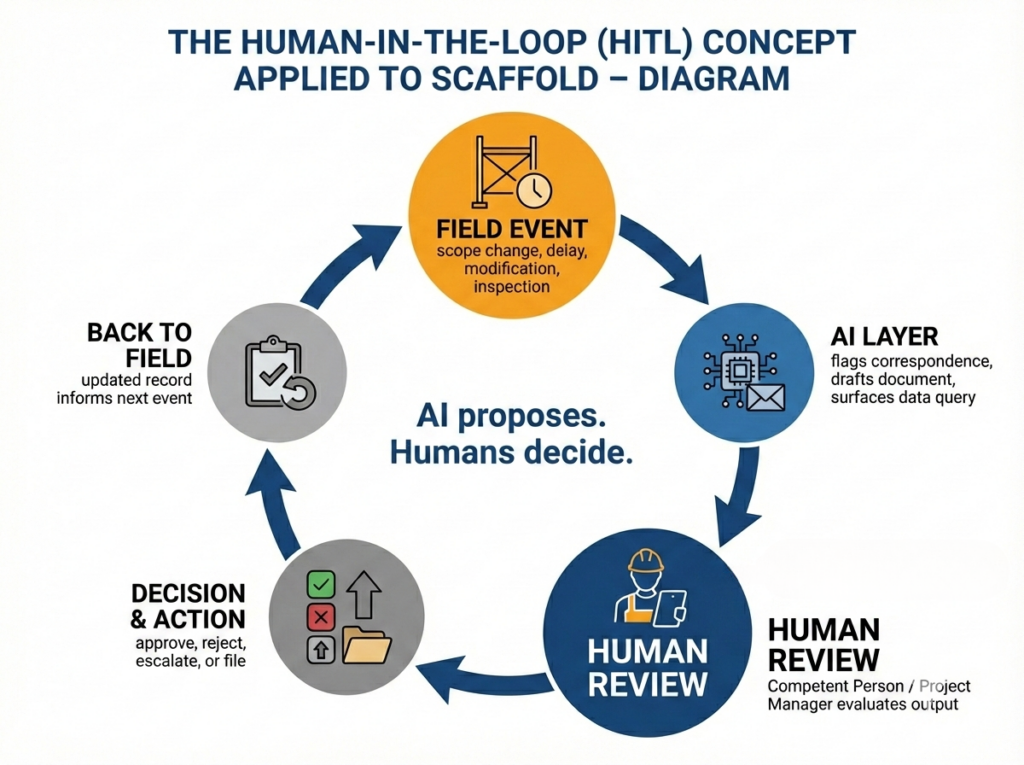
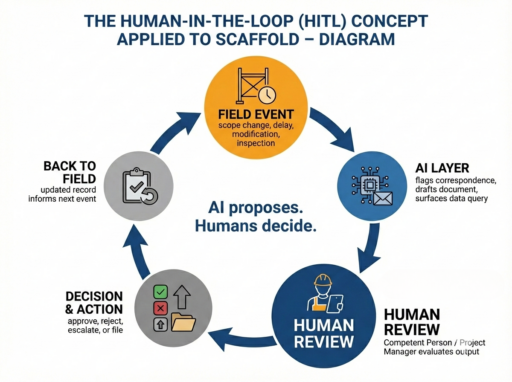
The right framework for understanding AI in scaffold operations comes from AI system design: the human-in-the-loop, or HITL. It describes systems where humans remain active and accountable at every consequential decision point, rather than delegating control to automation. Every credible AI application in this industry operates on HITL principles.
This structure aligns directly with current scaffolding industry standardsthatexist precisely because certain decisions demand trained human judgment, which no AI system currently meets or is designed to. Put simply: the AI handles volume while the trained professional handles accountability. One makes the other more effective.
These aren’t speculative scenarios. AI tools are already operating in scaffolding and scaffolding-adjacent workflows across the industry, and in each case, a trained professional remains the decision-maker.
In yard and inventory management, computer vision systems can propose equipment counts and flag discrepancies from photo data, with staff verifying results before they affect inventory records.
In project intelligence, scaffolding software natural language interfaces are already enabling managers to take the guesswork out of site management by querying complex project data in plain English that surface insights about change requests, site delays, or underutilized inventory, while the project manager interprets those findings and decides what action to take.
In site safety monitoring, AI can surface patterns across inspection and incident data to predict serious injuries before they occur, allowing safety managers to review findings and implement corrective actions.
The scaffold industry faces the same demographic reality as the broader construction sector in which experienced workers are aging out faster than new workers are coming in. AI doesn’t solve for that shortage, but it changes the math. Administrative tasks that previously required an experienced project manager can be handled by a less experienced staff member with AI assistance, including reviewing closeout documents for unbilled work, drafting professional correspondence, and querying project data. With AI your senior people can focus exclusively on work that requires judgment built over decades. In a tight labor market, that productivity multiplier is the difference between turning away work and taking it.
AI proposes; humans decide. This dynamic is not a limitation. Instead, it is a necessary safeguard in an industry where safety accountability rests with professionals. At stake are OSHA citations that can scale from $16,550 for serious violations to over $165,000 for willful or repeated offenses.
Prompt writing is a skill your staff need to develop. The gap between useful AI output and generic output is almost always the instruction or the ‘prompt.’ Specificity produces results; vagueness produces rewrites.
Generic: ‘Write a delay notification’ produces nonsense or made-up information that needs to be written from scratch.
Specific: ‘Draft a formal notice to the project manager: wind-related stoppage today, OSHA 1926.451(f)(12), our competent person halted at 10:40am when sustained winds exceeded 20 mph, work resumes pending tomorrow’s re-inspection. Professional, factual, one page.’ Produces a draft needing a signature, not a rewrite.

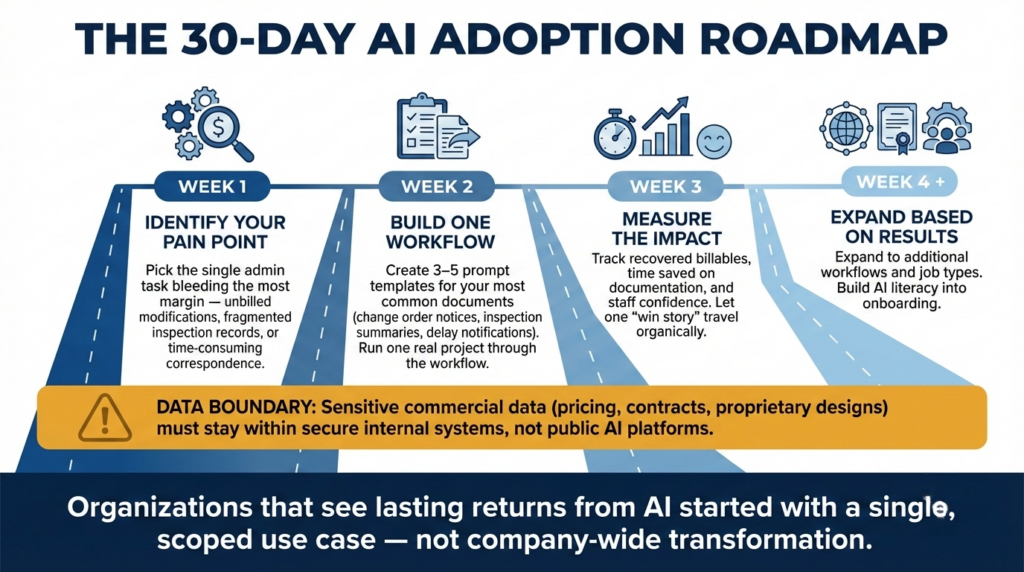
Organizations that see lasting returns from AI share one approach: they started with a single, scoped application or use case, rather than company-wide transformation. Pick the administrative pain point that costs the most like unbilled modifications, fragmented inspection records, or time-consuming correspondence. Then build one workflow around it. Measure the impact over 30 days before expanding.
Mandatory rollout creates resistance. Early adopter success creates converts and advocates who make it easier to make change organic and part of a positive culture shift. If a project manager discovers that an AI-assisted closeout review surfaced $18,000 in legitimate unbilled work on a single project, that story spreads without an intensive training program behind it. Set one firm limitation from the start: sensitive commercial data like pricing, contracts, and proprietary designs need to stay within secure internal systems, not public AI platforms.
The most durable investment here is in AI literacy: not software-specific training, but the foundational understanding of how these systems work, where they fail, and what human oversight looks like in practice. With the industry-wide push on workforce development as a core priority, expanding training to address new industry challenges like AI literacy is one area to watch. Companies that build AI use into onboarding and ongoing development will have a meaningful operational advantage over those treating it as an optional extra.
AI systems produce confident output even when they are wrong. A query about ANSI codes may return fabricated references. A drafted clause may read professionally while carrying legal exposure. Every person using these tools needs to understand: AI output is an informed draft, not a final document. Human review is not optional but the mechanism that makes the whole system work. Accountability does not transfer to the software, it stays with the business.
With an estimated 4.1% average net margin, scaffolding leaves no room for operational slippage. Unbilled change orders, unrecoverable inspection records, and time-consuming documentation processes are not strategic failures — they are administrative ones, and they are solvable. The human-in-the-loop framework ensures that solving problems with AI does not introduce new risks in place of old ones. In an industry where finding qualified people can be harder than finding work, the margin your limited crew earns on the jobsite should reach your bottom line and your best people should spend their time on problems that require their expertise, not problems a well-designed system can solve.
Brian Webb is Founder and CEO of Avontus Software. With a background in civil engineering and scaffold design, he guides the development of software for scaffold operations and inventory.
Human-in-the-loop (HITL) describes an AI system where people stay active and accountable at every decision that matters. In your yard or office, AI can draft a notice, flag a mismatch, or propose an equipment count. A trained professional reviews the result and decides what happens next.
No. Document review, data questions, and field-to-office messaging remove paperwork from your day, but none of them replaces the judgment of the competent person OSHA requires. The stakes are high: OSHA penalties range from $16,550 for a serious violation to more than $165,000 for a willful or repeated one (2024 inflation adjustments).
Small, undocumented changes pile up. A foreman moves a bay at the GC’s request, the crew spends six hours on it, and the message gets buried in 200 texts by month-end closeout. At a fully loaded field rate, six untracked hours cost you $500 to $600 in recoverable revenue. Do that twice a week across five jobs, and no volume of new work will outrun the leak.
Start small. Choose one administrative pain point, such as unbilled modifications, scattered inspection records, or time-consuming correspondence. Build one workflow around it and track the impact for 30 days. Keep sensitive commercial data, including pricing, contracts, and proprietary designs, inside secure internal systems and out of public AI platforms.
Give the AI specifics. A vague request like “write a delay notification” returns generic text that you rewrite from scratch. A detailed request names the recipient, the cause, the OSHA reference, the time the competent person halted work, the conditions, and the restart plan. That request returns a draft that needs only your signature.
Not without review. AI can sound confident while being wrong. A query about ANSI codes can return references that do not exist, and a drafted clause can read well while carrying legal risk. Treat every output as an informed draft and keep a person responsible for the final version.
AI does not fix the shortage, but it changes the math. A less experienced team member with AI assistance can review closeout documents for unbilled work, draft correspondence, and query project data. Your senior people then spend their time on the work that needs decades of judgment.
AI literacy is a working understanding of how these systems function, where they fail, and what human oversight looks like. It is not training on one software product. Building it into onboarding and ongoing development gives your team the skill to know when to trust a result and when to check it.
While manual counts resets the baseline, “drift” begins the moment operations resume, creating a widening gap between system records and… Read More
The NASC Skills Gap Report 2026 has put a number on something every scaffold business owner in the UK already… Read More
While manual counts resets the baseline, “drift” begins the moment operations resume, creating a widening gap between system records and… Read More