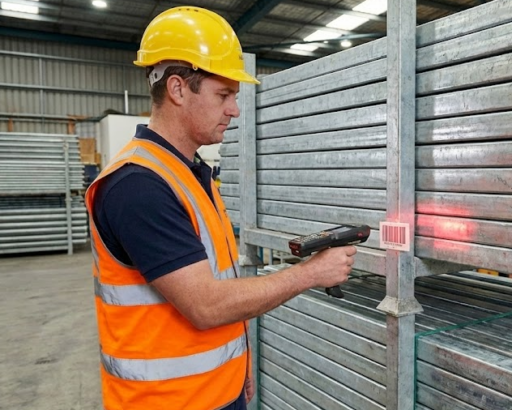
Stop Scanning Items One by One: Barcode Group Scanning Is Here
If you’ve ever found yourself standing in a yard with a clipboard, manually counting equipment piece by piece while a… Read More
(Reposted from an Avontus Software article in SA magazine, Jan/Feb 2026)
Most scaffold companies value precise inventory counts, yet many quietly struggle to maintain them. The challenge is not a lack of discipline. Rather, scaffolding operations create specific conditions in which count integrity naturally drifts unless it is actively managed across the entire organization.
Understanding this requires looking beyond one-time counts toward daily operational realities.
Scaffold inventory is fundamentally different from most construction materials. Several factors create a perfect storm for inconsistency:
Inventory integrity rarely fails because people do not care; it fails at operational touchpoints. Every transaction introduces the potential for timing gaps. When manual processes track industrial-scale movement, small delays quickly compound. Accordingly, precision is a team-wide responsibility. From estimators allocating gear to field crews returning it, every role affects visibility. When one group is excluded, accuracy suffers.
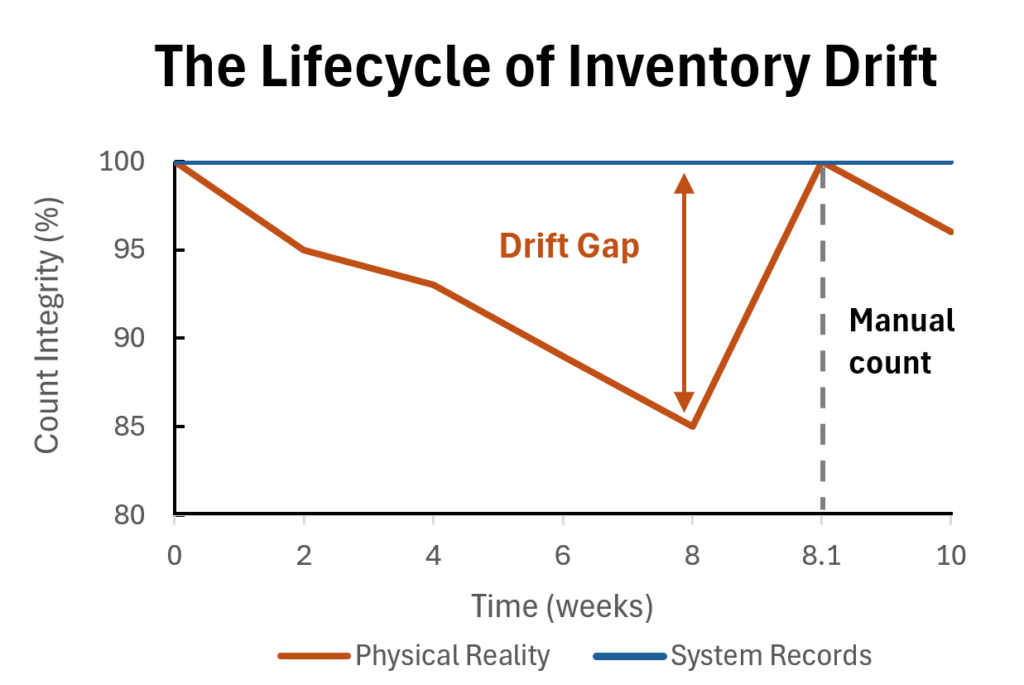
When companies physically verify material on hand against system records, they create a necessary – but temporary– moment of certainty. As operations resume, data reliability begins drifting as static snapshots cannot keep pace with continuous movement. Count precision is not a one-time event; it is the result of ongoing operational behavior. Without participation from all teams who touch inventory, “drift” is inevitable.
While drift is an operational headache for the yard, it is a profit drain for the executive team.
The American Rental Association (ARA) identifies utilization as a critical performance metric for rental businesses. Flawed records invalidate these calculations:
If equipment sits unrecorded in a yard or forgotten on-site, it becomes functionally invisible and yields 0% utilization. Every day it remains uncounted means lost revenue. Inaccurate inventory leads to poor capital expenditure (CapEx) decisions, such as purchasing new material or re-renting equipment from a competitor because owned material cannot be located.
Furthermore, inventory drift is a labor killer. Labor is a primary income stream, but it is entirely dependent on having the right components. A scaffold build can be completely halted by a lack of relatively inexpensive items such as baseplates. When drift hides these critical pieces, you lose both the rental revenue of the large-tonnage items and the billable labor hours of the crew standing by. Unreliable data does not just hide gear; it paralyzes your most expensive resources.
Under GAAP (Generally Accepted Accounting Principles), missing equipment that remains on the books is a “ghost asset”, creating waste in several ways:
Many owners fear this scenario: A mid-sized scaffold provider recently rediscovered a forgotten project that had been standing for nearly three years. The job was finished, the crew had left, and the paperwork was lost during a staff transition. Because the company lacked a platform that flagged long-idle inventory, the gear sat unused on a quiet industrial site with a “to be dismantled” status. The cost was not just the $20,000 replacement value; it was the opportunity cost of three years of lost rental revenue and three years of insurance payments on equipment that was not earning a dime.
Successful companies use a combination of three mechanisms:
In retail or manufacturing, inventory is a short-term asset destined for sale. In our industry, scaffolding is a long-lived, revenue-producing fixed asset. Fixed assets require ongoing validation because their worth depends on constant movement. ARA standards tie asset value to cycles. If a piece is missed, you lose the net present value of every future rental hour that piece would have provided.
Unlike a truck with a VIN or a motor with a serial number, a 7-foot ledger is “fungible” as it is interchangeable with any other seven-foot ledger. This lack of unique identity makes loss easy to hide and blurs accountability. When any piece will do, material can quietly circulate between jobs, yards, and even re-rent without a clear record of where it originated or who is accountable. Discrepancies only surface when systems track job-level responsibility rather than just total “stock” in the yard.
Inventory touches nearly every role. Estimators influence accuracy by determining what is allocated to a job. Field crews determine what physically returns, and the billing department depends on that visibility to charge correctly. Sustainable accuracy comes from shared ownership, not strict enforcement.
The real question is not how much gear you have, but: “How do all parts of the company help prevent inventory accuracy from drifting?” Companies that answer this well treat inventory as an ongoing process supported by systems that reflect operational reality.
Avontus Quantify was built for real scaffold operations, not idealized models. The inventory management app supports unlimited users, so the entire team operates from a single source of truth. Quantify handles negative balances, separates company-owned from re-rented material, and provides job-level accountability without blocking work.
By maintaining precise visibility into where gear is deployed, companies reduce unnecessary re-rent and improve utilization. Count reliability improves because the system matches how scaffold operations truly function. With this operational data captured in real time, Quantify’s billing engine can use that same delivery, return, and transfer data to generate invoices in a single click. Companies bill with greater speed and with greater confidence.
Learn more about Avontus Quantify‘s scaffold-specific inventory management features.
Brian Webb is Founder and CEO of Avontus Software. With a background in civil engineering and scaffold design, he guides the development of software for scaffold operations and inventory.
The reality is that scaffold inventory faces a perfect storm of tracking challenges. You’re managing thousands of individual components, each with relatively low unit value, which means losing a few pieces here and there doesn’t immediately set off alarm bells. But here’s where it gets tricky: yard transactions often happen after the physical movement, creating those frustrating temporary negative balances in your system.
Then there’s the job-to-job transfer problem. Material gets redeployed directly between sites without ever touching the yard, leading to unexplained shortages and mysterious over-returns. Add in the complexity of tracking your owned gear separately from re-rented equipment, and you quickly realize that standard inventory tools just weren’t built for this kind of operation.
Think of a physical count as hitting the reset button—it gives you that clean slate moment where everything matches up. The problem? Operations don’t stop. The minute your crews start moving material again, that perfect accuracy starts slipping away.
Here’s what actually happens: those static snapshots you took during the count can’t keep up with scaffold moving constantly across multiple job sites. So while counts are absolutely necessary, they’re not sufficient on their own. Real accuracy comes from how your entire team handles inventory day-to-day, from the estimator allocating gear to the field crew returning it to the billing clerk charging for it.
Inventory drift is that gradual disconnect between what your system says you have and what’s actually out there. It’s not dramatic—it’s death by a thousand cuts. Your utilization numbers become meaningless because you’re making decisions based on bad data. You might buy new equipment when perfectly good gear is sitting forgotten on some job site. Or worse, you’re paying taxes and insurance on “ghost assets” that walked off months ago.
Ghost assets are the scaffold equivalent of paying rent on an apartment you moved out of months ago. They are items that disappeared from your yard but are still living comfortably on your balance sheet. Under GAAP accounting rules, this creates real financial pain.
You’re paying property taxes on equipment you don’t have. Insurance premiums on gear that’s long gone. Your bank uses inventory as collateral, so when they eventually audit and find significant drift, your borrowing capacity can take a hit. And if you’re thinking about selling the company? Buyers will do their own physical-to-book reconciliation, and high drift screams “operational problems”—which translates directly into a lower offer.
Because inventory touches everyone, and everyone touches inventory. Your estimator determines what gets allocated to each job. Your field crew decides what actually comes back (and in what condition). Billing needs accurate data to charge correctly. Yard staff handle the physical transactions.
Break that chain anywhere and accuracy suffers. If estimators are working in one system and the yard in another, you’ve got problems. If field crews don’t care about returns because “someone else handles that,” you’ve got problems. Sustainable accuracy doesn’t come from one person being the inventory cop—it comes from shared ownership and systems that give everyone real-time visibility into the same information.
If you’ve ever found yourself standing in a yard with a clipboard, manually counting equipment piece by piece while a… Read More

Note from the Editor: As 2021 draws to a close, we’d like to first give a shoutout to all of… Read More